The fastest way to get rid of aphids without chemicals is a strong jet of water from a hose. It knocks them off the plant, and most cannot climb back. Do it again every 2 or 3 days for about two weeks. Remove small groups with your fingers, cut off shoots that are covered, and let ladybugs and other natural enemies do the rest. In most gardens, this is sufficient.
How do you know that it is aphids?
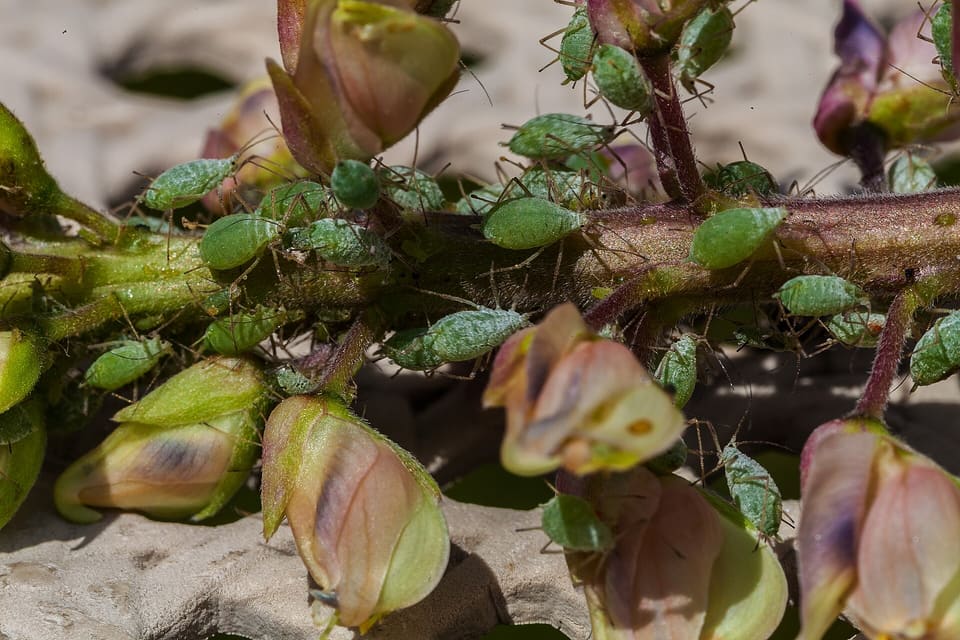
Aphids are small, soft insects with a pear shape, about 1/16 to 1/8 inch long. They can be green, black, gray, yellow, or pink. They sit close together on the youngest, softest parts of a plant: shoot tips, flower buds, and the lower side of leaves.
Look for these signs:
- Groups of small insects that hardly move when you touch the leaf.
- Young leaves that curl or twist.
- A sticky, shiny layer on the leaves below. This is honeydew, the sweet liquid that aphids release.
- A black layer that grows on the honeydew. This is sooty mold.
- Ants that walk up and down the stems. Ants collect honeydew and protect aphids from their enemies.
- Small white flakes on the leaves. These are the old skins of aphids.
Aphids feed on plant sap. A small group does little damage. A large one slows growth, deforms new leaves, and can carry plant viruses from one plant to the next.
Why do they multiply so fast?
In spring and summer, female aphids give birth to live young without mating, and the young are adults in about a week in warm weather. So a few aphids can become hundreds in a short time. This is why you must look early and act more than one time. One treatment is rarely sufficient.
Step 1: Use a jet of water
Hold the stem or the leaf with one hand and spray it with a firm jet from the hose. Point the water at the lower side of the leaves and at the shoot tips. Aphids are slow and soft, and most that fall do not find the way back.
Do it in the morning so that the leaves dry before night. Do it again every 2 or 3 days, because you always miss some, and those continue to reproduce. For seedlings and soft plants, use a spray bottle or a gentler stream so that you do not break the stems.
Step 2: Remove them by hand
On houseplants, seedlings, and small groups, your fingers are the most exact tool. Slide your thumb and finger along the stem and crush the aphids, or wipe them off with a damp cloth. Use gloves if you prefer.
If one shoot tip is completely covered, cut it off and put it in the trash, not on the compost pile. The plant grows a new tip quickly. Favas (broad beans) are a well-known example: when the lowest pods start to form, pinch out the soft tops, which are the part that black aphids like most.
Step 3: Let their enemies work
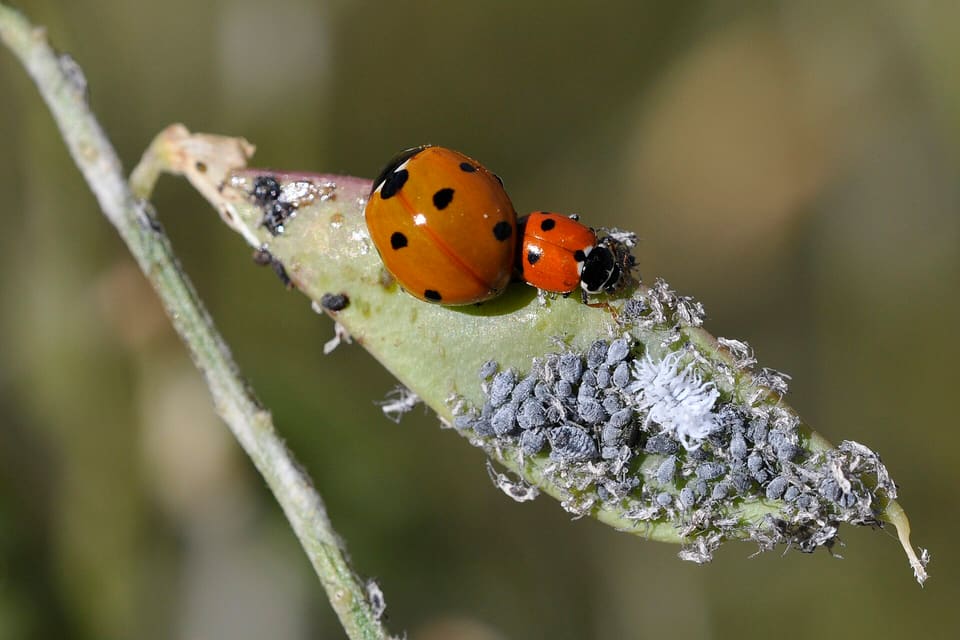
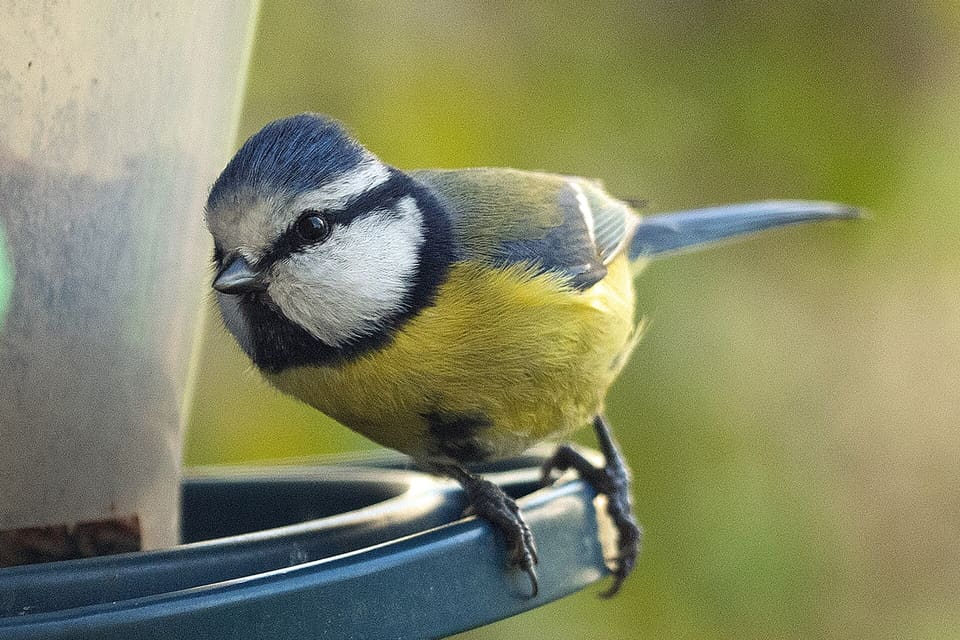
Many animals eat aphids. Ladybugs and their larvae are the best known. The larvae look like small gray-black alligators with orange spots, so learn to recognize them and leave them in place. Lacewing larvae and hoverfly larvae eat large numbers too. Very small wasps lay their eggs inside aphids, and you can see the result as brown, swollen aphid shells with a round hole. Small birds such as chickadees collect aphids for their young.
To bring these helpers into your garden:
- Grow flowers with open, flat heads near your vegetables: dill, fennel, cilantro that you let flower, sweet alyssum, calendula, and yarrow. Adult hoverflies and lacewings feed on their nectar and pollen. The guide to plants for pollinators lists more.
- Do not use broad insect sprays. They kill the helpers too, and the aphids come back faster than their enemies.
- Accept a few aphids. Without food, the predators leave.
When aphids first appear in spring, it often takes a week or two before the predators arrive. Use the water jet in that time.
If these steps are not sufficient
For a heavy attack, insecticidal soap is an option. It works only on the insects that it touches and leaves no lasting layer. Use it as its label says, cover the lower side of the leaves, and spray in the evening when bees are not active. Remember that it harms soft helper insects too if it touches them, so use it on the problem places only, not on the whole garden.
How to prevent the next attack
- Feed with care. Too much nitrogen fertilizer gives soft, fast growth, which is what aphids look for. Compost and slow feeding give stronger plants.
- Look each week. Turn some leaves over when you water, mainly on roses, beans, cabbage plants, peppers, and fruit trees. Ten aphids are easy to remove. A thousand are not.
- Keep plants strong. A plant with good soil and regular water tolerates more.
- Look at new plants. Examine houseplants and transplants before you put them near your other plants.
Aphids are only one of the pests in a vegetable garden. For barriers, traps, crop rotation, and the full plan, see the guide to organic pest control for vegetable gardens. You can also find more articles on the garden pests topic page.