The best garden path ideas for a first project are the simple ones: wood chips, gravel, stepping stones, brick on sand, and a mown path through grass. None of them needs concrete or special tools. Choose by how often you use the path and how much you want to spend.
Where should a path go?
Before you choose a material, decide the line.
- Follow your feet. Look at where the grass is worn. People take the shortest way from the door to the shed, the compost, and the tap. A path that ignores this stays empty, and the worn track stays too.
- Mark it out first. Lay a hose or a rope on the ground, or scatter a line of sand. Walk it for a few days, with a wheelbarrow if you use one, and adjust it.
- Decide the width. A main path needs 3 to 4 feet, so two people can pass or a wheelbarrow fits. A path between vegetable beds can be 18 to 24 inches. Wider than that takes space from the beds.
In a small plot, the line of a path also changes how large the space feels. The guide to small garden design ideas explains why a diagonal line helps.
The five paths at a glance
| Path | Cost | Work | Best for |
|---|---|---|---|
| Wood chips | Very low | Very easy | Paths between beds, woodland corners |
| Gravel | Low to medium | Medium | Main paths in a dry, sunny garden |
| Stepping stones | Low | Easy | A route across a lawn or a bed |
| Brick on sand | Medium | More work | A main path near the house |
| Mown path | None | Easy | A large lawn or a meadow area |
1. Wood chips
This is the fastest path of all, and the softest to walk on.
- Clear the weeds and level the line roughly.
- Lay plain cardboard on the soil, with the edges overlapping. It stops weeds and rots away in time.
- Spread 3 to 4 inches of wood chips on top.
Top it up every year or two, because the chips break down. That is not a fault: the old layer becomes good soil that you can rake onto the beds. The same material works on your beds, and the guide on how to mulch a garden shows how to use it there.
2. Gravel
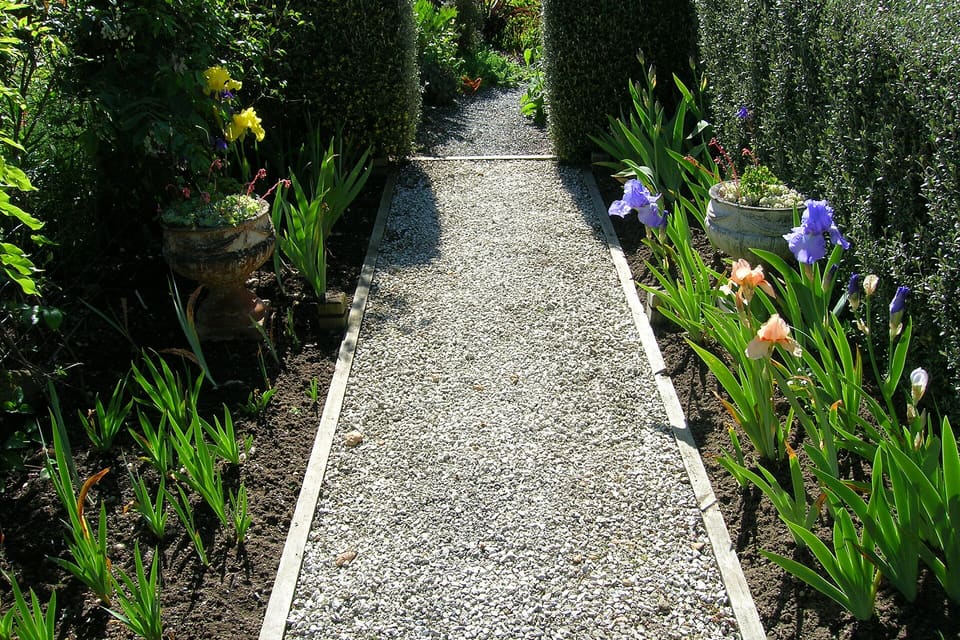
A gravel path drains well, crunches underfoot, and suits most styles.
- Dig out the line to a depth of about 4 inches.
- Fix an edge on each side: boards with pegs, bricks, or steel edging. Without an edge, gravel moves into the beds and the lawn.
- Lay landscape fabric that lets water through. It keeps the gravel and the soil apart.
- Add about 2 inches of crushed stone as a base and tamp it down firmly.
- Spread 1 to 2 inches of gravel on top and rake it level.
Choose angular gravel of about 3/8 inch. It locks together and stays firm. Round pea gravel rolls below your feet.
3. Stepping stones
Stepping stones give you a dry route with very little material. Use flat natural stone, concrete pavers, or thick slices of a hardwood log.
- Lay the stones on the ground and walk over them at your normal pace. Move them until each step lands in the middle of a stone. For most people that is about 24 inches from the center of one stone to the center of the next.
- Cut around each stone with a spade, and lift the turf or soil.
- Dig a little deeper, add an inch of sand, and bed the stone on it.
- Set each stone level with the ground or just below it, so the mower passes over.
4. Brick on sand
Brick takes more work, but it gives a firm, level path that lasts for decades. You can lift and lay it again if it settles.
- Dig out about 7 inches: 4 inches for the base, 1 inch for sand, and the depth of a brick.
- Fix a firm edge on each side. The edge holds everything in place, so do not skip it.
- Fill in 4 inches of crushed stone in two layers, and tamp each layer hard.
- Spread 1 inch of coarse sand and level it with a straight board.
- Lay the bricks close together in a simple pattern, such as running bond or basket weave. Work from the part that is already laid, and do not step on the sand.
- Sweep fine, dry sand into the joints until they are full. Sweep in more after the first rain.
Use paving bricks, which are made to lie on the ground and to stand frost. Ordinary wall bricks can crumble after a few winters. Reclaimed pavers are a good choice: see the post on zero-waste gardening for more to reuse.
5. A mown path
If you have a large lawn, let a part of it grow long and mow a path through it. The path costs nothing, you can move it each year, and the long grass with its flowers is good for insects and birds.
Mow the path once a week in the growing season, at least as wide as two passes of the mower.
Which mistakes should you avoid?
- No base. Gravel and brick that lie directly on soil sink and go uneven in a year or two.
- No edge. Loose material spreads, and bricks drift apart.
- No slope. A flat path holds puddles. Let it drop slightly to one side, about a quarter inch for each foot of width.
- Slippery in shade. Smooth stone and wood grow algae in damp shade. Use gravel or wood chips there.
What to do next
Mark out one path this weekend with a hose, and walk it for a few days. Start with wood chips if you are not sure: they are easy to change later. If the path is one part of a new vegetable area, read how to plan a raised bed vegetable garden, which gives the right widths for paths between beds.