To plan a raised bed vegetable garden, make four decisions in this order: where the beds go, how large they are, how you move between them, and what grows in each one. Make them on paper before you buy wood or soil. A bed that is in shade, or too wide to reach across, is hard to correct after it is full.
Where should the beds go?
Sun comes first. Most vegetables need 6 to 8 hours of direct sun in the growing season. Look at your yard in the morning, at noon, and in the late afternoon, and note where the shadows of buildings and trees fall. Remember that the sun is lower in spring and fall, so shadows are longer then. Leafy crops such as lettuce and spinach grow with 4 to 5 hours, so a place with less light is still useful for them.
Water comes second. A bed that is far from the faucet gets less water than it needs, because carrying cans is hard work. Put the beds where a hose can reach them easily.
Then look at the ground. A level place is best. On a slope, set the beds across the slope and level each frame. Do not choose a low place where water stays after rain. Keep some distance from large trees, because their roots grow into the rich soil of a bed and take the water.
A place that you see from the kitchen or pass each day is better than a hidden corner. You notice dry soil and ripe beans when you walk past them.
What size should a raised bed be?
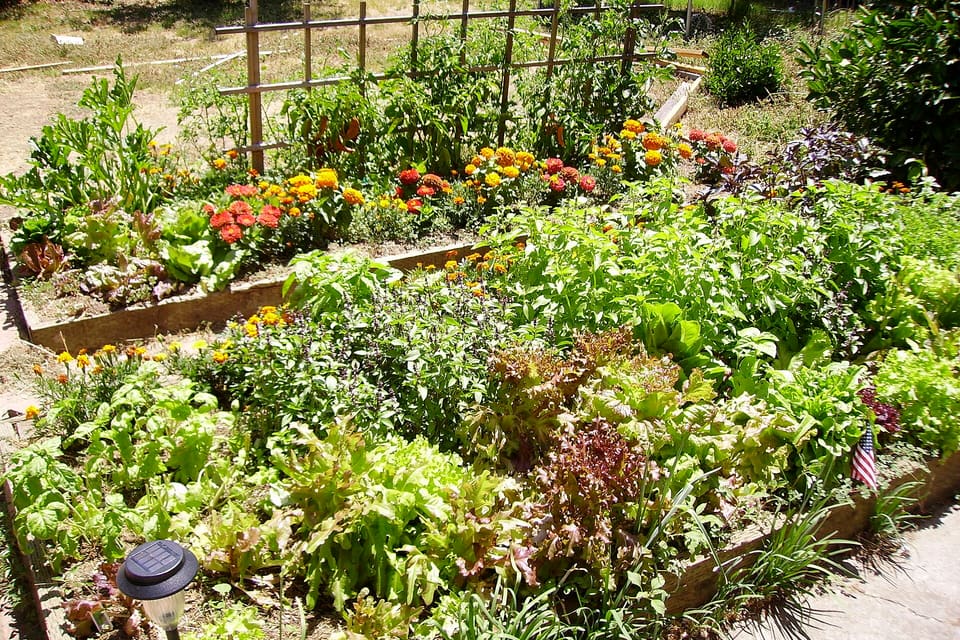
Width. The rule is that you never step on the soil. Soil that nobody walks on stays loose, and roots grow well in it. Most adults can reach about 2 feet, so a bed with access from the two long sides can be 4 feet wide. A bed against a fence or a wall has access from one side only, so make it 2 to 2.5 feet wide. For children, 3 feet is a better maximum.
Length. The length is free, but 6 to 8 feet is practical. A very long bed tempts you to step across it. Common lumber lengths also divide into these sizes with little waste.
Depth. For most vegetables, 10 to 12 inches of good soil is sufficient, more so if the ground below is soil and the roots can continue down. Carrots and parsnips prefer 12 inches or more. If the bed stands on paving, or if you want to garden without bending, plan for 18 to 24 inches.
How wide should the paths be?
Paths are easy to forget, and narrow paths are the most common planning mistake. Leave 18 to 24 inches between beds so that you can kneel and turn. Make the main path 3 feet wide if a wheelbarrow must pass.
Cover the paths so that weeds do not move into the beds. Wood chips on top of plain cardboard are cheap and comfortable to kneel on. Grass paths are an option too, but they must be as wide as your mower, and the edges need a trim.
What should the frame be made of?
Untreated wood that resists rot, such as cedar or larch, is the usual choice and lasts for many years. Cheaper softwood works but has a shorter life. Boards of 1.5 to 2 inches in thickness bow less than thin ones. Metal beds and stone or brick walls last longest. Do not use old painted wood or railroad ties for beds where you grow food.
On a small budget, you can also make a bed with no frame: a flat mound of soil and compost, 6 to 8 inches high, with sloped sides.
What goes inside the bed?
Plan the filling before you build, because it is often the largest cost. A common mix is topsoil with a generous part of compost. Loosen the ground below the frame with a fork first, so that water drains and roots can go deeper. To calculate the volume, multiply the length, the width, and the depth. A bed of 4 by 8 feet with a depth of 1 foot holds 32 cubic feet. The soil calculator does this sum for any size, and tells you how many bags that is.
The soil level falls in the first year as the material settles. Add compost each spring. The guide to improving garden soil explains how to keep the soil in good condition, and you can make part of the compost yourself if you start composting at home.
How do you lay out the crops?
Draw each bed on paper and divide it into blocks, or lay it out square by square with the raised bed planner.
- Tall crops to the north. Put tomatoes, pole beans, and corn on the north side, with a trellis on the north edge. Then they do not shade the plants in front.
- Short crops to the south. Lettuce, radishes, carrots, and herbs go at the front, where they get full light.
- Give each plant its space. A tomato needs about 2 feet in each direction. A zucchini needs 3 feet. Lettuce is content with 8 to 10 inches. The seed packet gives the distance.
- Group crops by water needs. Thirsty crops together are easier to water correctly.
With two or more beds, move each crop family to a different bed each year. This rotation makes it harder for soil diseases and pests to build up.
For the timing of each crop, see what to plant in each season.
Common planning mistakes
- Too many beds in the first year. Two beds that you look after well give more food than six that you cannot keep up with. You can add more later.
- No plan for water. Decide now if you will use a can, a hose, or a line along each bed. The comparison of a drip irrigation line and a soaker hose helps you choose.
- Beds against a fence at full width. You cannot reach the back.
- Plants too close. Crowded plants compete for light and get more disease.
If your space is very small, one bed and a few pots can still feed you well. The small garden design ideas show how to fit more into a tight yard.