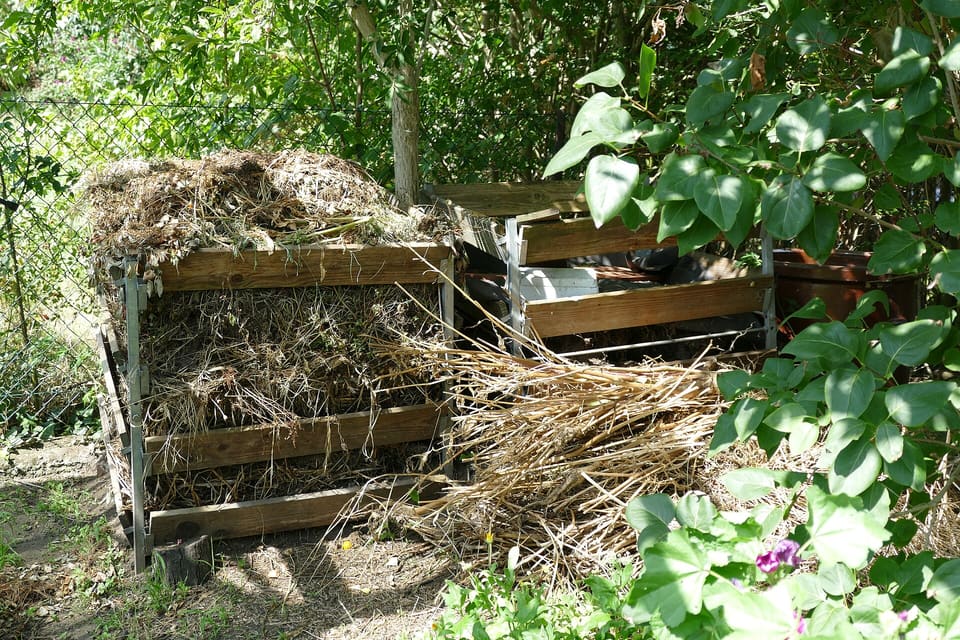
To start composting at home, you need a bin or a corner of the yard, a mix of wet green waste and dry brown waste, and some patience. Put the materials in layers, keep the pile moist, and turn it now and then. In six months to a year, you have dark, crumbly compost for your beds. It costs almost nothing, and it keeps a large part of your household waste out of the trash.
Choose a bin and a place
Any of these will work. Choose by the space that you have.
- An open pile or a bay made from pallets or wire is the cheapest choice. It suits a larger garden with a lot of leaves and clippings.
- A closed plastic bin with a lid is tidy, holds moisture and heat, and fits a small yard.
- A tumbler is a sealed drum that you turn with a handle. It is easy to turn and keeps animals out, but it holds less.
- A worm bin works on a balcony or indoors and takes kitchen scraps only.
Put the bin on bare soil if you can, so worms and other soil life can move in from below. A spot in light shade is best, because the pile does not dry out as fast there. Make sure that you can reach it easily from the kitchen, also in winter. A pile of about 3 feet in each direction is large enough to warm up and small enough to turn.
What goes into compost?
Composters speak of greens and browns. Greens are soft, moist, and rich in nitrogen. Browns are dry, tough, and rich in carbon. The pile needs both.
| Greens | Browns |
|---|---|
| Fruit and vegetable scraps | Dry fall leaves |
| Coffee grounds and tea leaves | Torn cardboard and egg cartons |
| Fresh grass clippings | Straw |
| Soft green prunings | Shredded plain paper |
| Old flowers and plants | Small twigs and wood chips |
Crushed eggshells can go in too. They break down slowly, but they do no harm.
What stays out?
- Meat, fish, bones, dairy, fat, and cooked food. They smell and attract rats.
- Dog and cat waste.
- Plants with disease, and weeds that have set seed or that spread by roots. A home pile seldom gets hot enough to kill them.
- Glossy or coated paper.
- Wood that was treated or painted.
- Grass clippings from a lawn that was treated with weed killer.
How do you build the pile?
- Start with a layer of coarse browns, such as twigs or stalks, a few inches deep. It lets air in from below.
- Add greens and browns in turn. For each bucket of greens, add two to three buckets of browns.
- Sprinkle water on dry layers as you go.
- Finish with a layer of browns on top. It hides the kitchen scraps from flies and holds in the smell.
You do not need to fill the bin in one day. Most households add a little at a time. Keep a bag of dry leaves or a stack of torn cardboard next to the bin, and cover each bucket of kitchen scraps with a few handfuls.
Small pieces rot faster than large ones. Chop thick stems, and tear cardboard into pieces the size of your hand.
Water and air
The living things that make compost need moisture and oxygen. Take a handful from inside the pile and squeeze it. It should feel like a wrung-out sponge: moist, with no more than a drop or two of water. If it is dry, water it. If it drips, add browns.
Turn the pile with a garden fork every few weeks. Move the material from the outside to the middle. Turning brings in air and speeds up the process. If you never turn the pile, you still get compost, but it takes longer.
How long does compost take?
It depends on the season, on the mix, and on how often you turn the pile. A pile that you turn regularly in warm weather can be ready in three to six months. A pile that you leave alone can take a year or more. The process slows down in winter and starts again in spring.
Compost is ready when:
- it is dark brown and crumbly,
- it smells of earth, not of rot or ammonia,
- you cannot recognize what went in, apart from a few twigs or eggshells.
Take the finished compost from the bottom of the bin. Put pieces that have not rotted back in to go around again.
How do you fix common problems?
The pile smells of rot. It is too wet, or it has no air. Mix in dry browns, and turn it.
It smells of ammonia. It has too many greens, often a thick layer of grass. Add browns, and mix.
Nothing happens. The pile is too dry, too small, or has too few greens. Add water and fresh greens, and turn it.
There are fruit flies. Bury the kitchen scraps in the pile, and cover them with browns each time.
Animals visit. Check that no meat or cooked food went in. Use a closed bin, and put wire mesh under it.
How do you use the compost?
- Spread 1 to 2 inches on vegetable and flower beds in fall or spring. This is the main step when you improve garden soil naturally.
- Put a layer around shrubs, roses, and fruit bushes as a mulch.
- Mix some into the soil of large pots. The guide to container gardening for beginners explains potting mixes.
- Sieve it and scatter it thinly on the lawn.
Compost is one part of a garden that wastes little. If you have more leaves than the bin can take, you can make leaf mold in a separate pile. For more ideas, such as reusing pots and saving seeds, see the post on zero-waste gardening.