To start seeds indoors, sow them in a moist, fine seed-starting mix, keep them warm until they sprout, and then give them strong light for 14 to 16 hours a day. Those three things, with careful watering, produce short, sturdy seedlings. Most failures come from the same few causes: seeds sown too early, light that is too weak, or mix that stays too wet. This guide takes you through each step in order.
Why start seeds indoors at all?
- You get a head start on crops that need a long, warm season, such as tomatoes and peppers.
- A packet of seeds costs less than one or two young plants.
- You can grow varieties that garden centers do not sell.
Not every crop wants it. Carrots, radishes, beets, peas, and beans dislike having their roots moved, and they grow quickly from seed sown straight in the bed.
When should you sow?
Find the average date of your last spring frost, and count backward. The guide on what to plant in each season explains how to find your frost dates.
| Crop | Weeks before the last frost |
|---|---|
| Onions, leeks, celery | 10 to 12 |
| Peppers, eggplant | 8 to 10 |
| Tomatoes | 6 to 8 |
| Cabbage, broccoli, kale | 5 to 7, to plant out before the last frost |
| Lettuce | 4 to 6 |
| Basil, marigolds, zinnias | 4 to 6 |
| Cucumbers, squash, melons | 3 to 4 |
The seed packet gives the same information for its variety, so trust it when it differs.
What do you need?
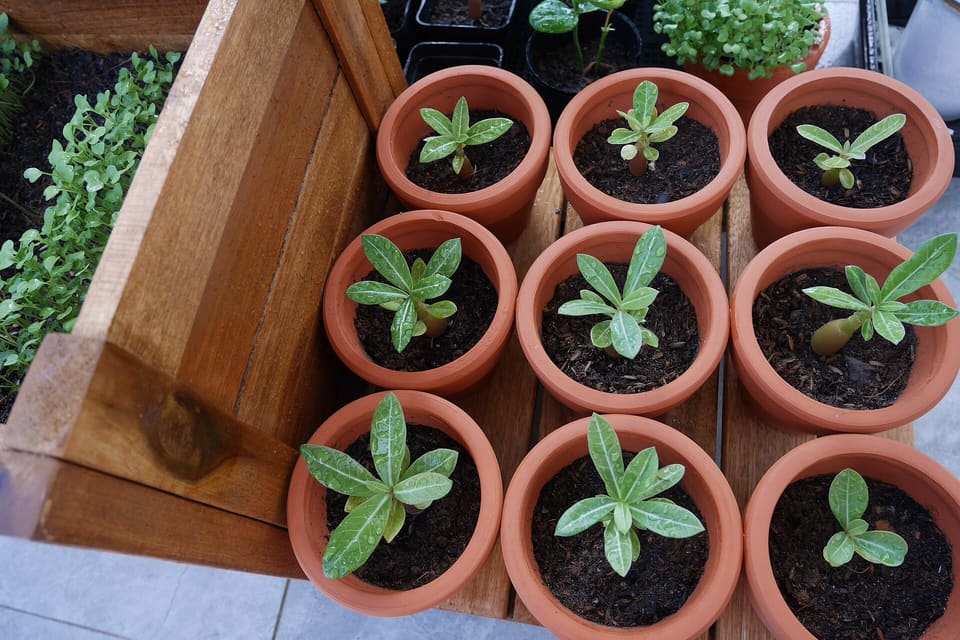
- Containers with holes. Cell trays, small pots, or reused yogurt cups with holes punched in the bottom all work. Wash used containers in hot, soapy water first.
- Seed-starting mix. It is fine, light, and free of weeds and disease. Garden soil is too heavy and often carries the fungi that kill seedlings.
- A tray without holes to stand the containers in, so you can water from below.
- A clear cover, such as a plastic dome or a clear bag, to hold moisture until the seeds sprout.
- Labels. Seedlings of different tomatoes look the same.
- Light. A simple LED shop light or grow light. A sunny windowsill is enough for a few pots, but most windows give leggy plants.
The post on zero-waste gardening has more containers that you can reuse.
How do you sow the seeds?
- Wet the mix first. Put it in a bucket, add water, and stir until it feels like a wrung-out sponge. Dry mix sheds water and floats seeds away.
- Fill the containers to just below the rim, and press down lightly.
- Sow at the right depth. As a rule, cover a seed with mix to about twice its own thickness. Press very fine seeds onto the surface and do not cover them. Sow two seeds in each cell.
- Label each row with the name and the date.
- Cover the tray with the dome or bag, and put it in a warm place.
How warm should it be?
Most vegetable seeds sprout best in soil at 65 to 75°F. Tomatoes, peppers, and eggplant like the warm end of that range. The top of a refrigerator or a shelf in a warm room is often enough. A seedling heat mat under the tray gives steady warmth and speeds up slow seeds such as peppers.
Check every day. As soon as the first green shoots appear, take the cover off and move the tray into bright light. Seedlings that stay covered and dark for even two days stretch and fall over.
How much light do seedlings need?
More than most people expect. Weak light is the main reason for tall, pale, floppy seedlings.
- Hang the light 2 to 4 inches above the tops of the plants.
- Run it for 14 to 16 hours a day. A timer makes this easy.
- Raise the light as the plants grow, so the distance stays the same.
On a windowsill, use your sunniest window and turn the pots every day.
How do you water and feed seedlings?
Water from below. Pour about half an inch of water into the tray, let the containers soak for 20 to 30 minutes, and tip out what is left. The surface should dry slightly before you water again.
A surface that stays wet invites damping off, a disease that pinches the stem at the soil line so the seedling falls over. There is no cure. Prevent it with clean containers, fresh mix, air movement, and careful watering.
Seed-starting mix has little food in it. When the seedlings have their first true leaves, which are the second set and look like the leaves of the adult plant, feed with a liquid plant food at a quarter to half the strength on the label, once a week.
When do you thin and pot on?
When the true leaves appear, keep the stronger seedling in each cell. Cut the other one off at the soil with scissors. Do not pull it, or you will disturb the roots of the one that you keep.
Move a seedling to a larger pot when its roots fill the cell or its leaves touch its neighbors. Hold it by a leaf, never by the stem.
How do you harden off seedlings?
Indoor plants are soft. Sun, wind, and cold nights can scorch or kill them in a day. Give them 7 to 10 days to adjust.
- Days 1 to 3: a few hours outside in the shade, out of the wind. Bring them in at night.
- Days 4 to 6: morning sun, then shade. A little longer each day.
- Days 7 to 10: out all day in full sun, and out overnight if there is no frost.
Plant them on a cloudy day or in the evening, and water them in well. If you plan to grow them in pots, the guide to container gardening for beginners covers pot sizes and mixes.